Tuesday, September 20, 2016

Dark net in Malaysia


Malaysia dark net 


In order to avoid occurrence bad thing happen in the future, we have to get enough information and knowledge of the thing that want to avoid First I would like to share some documentary movies about darkweb and secound i write about darknet in Malaysia .

1. Cyber secrets

Documentary/TV series 2013

Cyber Secrets is an educational web series that covers subjects ranging from digital forensics to hacking computers to security and intelligence gathering. Since the series covers so many subjects, everyone can learn something from watching. The first episodes cover Anonymity and the Tor Onion routing network. After that, the coverage moves toward forensics and then to hacking / system exploitation
Written by Jeremy Martin


2. Dark Net


Creator / Mati Kochavi

--
A documentary series that explores the furthest reaches of the internet and the people who frequent it, Dark Net provides a revealing and cautionary look inside a vast cyber netherworld rarely witnessed by most of us.

3. Dark Web
Crime | TV Series

Storyline
When Elizabeth Wallace's husband is arrested for running an Internet sub-network her charmed life is turned upside down when she is expected to carry on in the family business where he left off


4. Deep Web (2015)


Director and Writer: Alex winter

A feature documentary that explores the rise of a new Internet; decentralized, encrypted, dangerous and beyond the law

· Brooklyn Film Festival 2015 Nominated /Festival award Best documentary feature / alex winter 
· Montclair Film Festival (MFF) 201 Nominated/ Bruce Sinofsky Prize for Documentary Feature
 · Zurich Film Festival 2015 Nominated/ Golden Eye
Movie Awards

Best International Documentary Film/ Alex Winter


Tacklin This video about a global coalition of cyber-police pulled off one of the biggest sting operations in their history. It’s being called Operation ON-imm-uhs. 

The opposite of ANONYMOUS a bunch of their internet administrators and web retailers are in jail after police in 17 countries all coordinated a big sting operation. 


Authorities seized drugs, weapons, computers and illegal items during their coordinated raids. According to government officials in the US, United Kingdom, Ireland, the Netherlands and others, these suspects are now in custody for carrying out illegal acts, all on the Dark Webg Dark Web of crime Friday, 24 June By/ DATUK AKHBAR SATAR Institute of Crime and Criminology Help University Combating criminal activities operating in the Dark Web requires more proactive efforts compared to traditional security. It demands cyber security experts and technical resources combined with an innovative approach. 


The Malaysian government has to introduce a dedicated cybercrime unit to tackle the Dark Web. For short-term measures, the relevant law enforcement agencies and regulators should form a task force with Cybersecurity Malaysia and acquire the capabilities pertaining to Deep Web analysis. This is to enable the task force to effectively conduct investigations on serious criminal activities operating in the Dark Web.


 For long-term planning, the Government may consider forming a federal crime agency with a range of specialist capabilities to fight serious organised crime. The agency can respond to a wide range of threats including cybercrime, drug, human and weapons trafficking and economic crime. In 2013, the UK government formed the National Crime Agency (NCA) to fight serious and organised crime.


This law enforcement intelligence-led agency has launched a dedicated cybercrime unit to tackle the dark Web. Finally, Malaysia should also introduce a national plan to fight cybercrime. According to the 2014 Global Economic Crime Survey by PricewaterhouseCoopers (PWC), cybercrime will likely emerge as “the most popular” type of economic crime in Malaysia as more IT-related transactions are made in the future.


 Prevention and mitigation are other vital aspects in fighting cybercriminals and terrorists especially in the Dark Web. My personal opinion Before I write my opinion I would like to say that Most Malaysians learnt about The Dark Web following the recent of a heinous crime committed by a British pedophile.


 It emerged during the trial in which pictures and illicit videos were found posted on The Dark Web.my advice to every one is you must do security tips to help the Internet users minimize the risk of personal data: Update Web Browser, Change Passwords Regularly, Data Encryption.


 Be Wary of Public Wi-Fi Filter what you share on Social Networking sites In my opinion, The Malaysia Police must cooperate with Cybersecurity Malaysia to track down organized criminal activities such as pedophiles in the country as the Director of the Institute of Crime and Criminology, University HELP, Datuk Akhbar Satar said above .


Source : http://www.thestar.com.my/opinion/letters/2016/06/24/tackling-dark-web-of-crime/
 https://www.youtube.com
 https://www. imdb.com/


Monday, September 19, 2016

The Amazons of the dark net

THE first ever e-commerce transaction, conducted by students from Stanford and MIT in the early 1970s, involved the sale of a small quantity of marijuana. For decades afterwards, the online drugs trade was severely constrained by the ability of law enforcement to track IP addresses and the means of payment. The trickle of transactions threatened to become a flood with the emergence a few years ago of Silk Road, a drug-dealing site on the “dark net”. These e-depths cannot be reached through a normal browser but only with anonymising software called Tor. Buyers and sellers transact there pseudonymously in bitcoin, a crypto-currency.


Silk Road was shut last year with the arrest of Ross Ulbricht, the 29-year-old American whom investigators believe to be Dread Pirate Roberts, the site’s founder. Mr Ulbricht is due to stand trial in New York next January on charges that include computer hacking and money laundering. But law enforcers who predicted that Silk Road’s demise would mark the beginning of the end for online black-market bazaars were wrong. Instead, dozens of dark-net Amazons and eBays (also known as crypto-markets) have sprung up to fill the void. They are not only proving remarkably resilient but expanding their offerings and growing more sophisticated.

The number of for-sale listings in the 18 crypto-markets tracked by the Digital Citizens Alliance (DCA), an advocacy group, grew from 41,000 to 66,000 between January and August. The largest market until August, Silk Road 2.0 (whose logo, like its predecessor’s, features an Arab trader on a camel), has since been overtaken by two upstarts, Agora and Evolution, whose combined listings have grown by 20%, to 36,000 in the past two months. Each of these three has more listings than the original Silk Road ever did (see chart). It is unclear whether listings are a good measure of sales, which the markets do not disclose.


Vendors vary in size: the largest turn over several million dollars a month on a single site, the smallest a few hundred. They pay a fee to register and a commission per transaction, typically 3-6%. Buyers come from all over the world. Their purchases are sent by post—the vast majority appear to arrive undetected. Customer satisfaction is high.
Illegal and prescription drugs are the largest product category. (Some sellers are crooked pharmacists.) Silk Road 2.0, whose operators are avowedly libertarian, focuses almost exclusively on weed, powders and pills. Agora, whose mascot is an armed bandit, sells weapons, too. These are marketed mostly to Europeans, who face strict gun-control laws.
The fastest-growing of the big three, Evolution, is the least principled. Though, like the others, it bans child pornography, it hawks stolen credit-card, debit-card and medical information, guns and fake IDs and university diplomas. One-fifth of its listings are in its “Fraud” section or in “Guides and Tutorials”, which often explain how to commit crimes. Some see Evolution’s rapid growth as a worrying sign that cyber-criminals are looking to fuse their identity-theft operations with the “victimless” online drugs trade. (It is not, however, the most unsavoury corner of the dark net, where some make markets in contract killings.)
For drug buyers, online markets offer several advantages. They are less physically dangerous than street trades. This goes for dealers, too: a recent study found that a third or more of sales on Silk Road were to “a new breed of retail drug dealer”, a transformation of the wholesale market that “should reduce violence, intimidation and territorialism.”
Product quality is higher, largely thanks to an Amazon-like five-star customer-review system. With 29 reviews for the average listing on Silk Road 2.0, a high score provides reassurance. MDMA (or ecstasy) is particularly popular on the site, presumably because the street version can be laced with lethal impurities. The dark net’s hundreds of forums provide further intelligence on dodgy gear and scammers. The FBI made over 100 purchases on Silk Road before closing it down. An agent testified that these showed “high purity levels”.
High ratings are sellers’ lifeblood. Reputation is crucial when clients know they cannot fall back on small-claims courts or arbitration. “It’s the ultimate irony: a den of thieves who don’t know each other but need to trust each other,” says a researcher with the DCA who requested anonymity for reasons of security.
As drug sales move online, power is shifting to buyers. The big markets’ customer service and marketing strategies increasingly resemble those of legitimate retailers. They are quick to apologise for technical glitches. Two-for-one specials, loyalty discounts and promotional campaigns are common (on Smoke Weed Day, say). Other methods borrowed from the corporate world include mission statements, terms and conditions, and money-back guarantees. “It has become so prosaic it could be shoes,” says James Martin, author of “Drugs on the Dark Net”.
Markets are also innovating to cut fraud. In the free-for-all in the months after Silk Road’s closure, thousands of buyers lost bitcoins that were supposedly held in escrow, either because markets were hacked or because their administrators ran off with the money. The emerging solution is “multi-signature” escrow, from where funds can be moved only with the approval of a least two of the three interested parties (buyer, seller and market). Some markets are trying to build a community of trusted buyers and sellers with invitation-only participation. Those whose customers had bitcoins stolen have begun to devise schemes to make them whole.
Sites that specialise in stolen card data display their own brand of customer-friendliness. Some offer a service that allows buyers to verify purchased cards are still active, using compromised merchant accounts. The client’s balance is automatically refunded the value of cards that are declined. (Cards sell for anywhere from $10 to $100 each.) Others batch their cards for sale according to the location of the hacked retailer, says Brian Krebs, a cyber-security blogger. Buyers favour cards stolen from consumers who live nearby because banks often treat transactions as suspicious if they take place far from the legitimate cardholder’s home address. A site that has pioneered this segmentation is McDumpals. Its logo features a gun-toting Ronald McDonald and its motto is “I’m Swipin’ It”.
Several factors make life hard for those looking to crack down on the dark net, including its technical complexity, the physical separation of buyers and sellers, and their mobility (vendors typically post on more than one market, allowing them to keep selling if a site goes offline). Tellingly, the only market forcibly closed since Silk Road was Utopia, which was shut by Dutch authorities soon after it opened in February. Some law enforcers want to target Tor, but even if that were technically possible it would cause “collateral damage”, points out Nicolas Christin of Carnegie Mellon University, because the software has worthy uses, such as to protect whistleblowers.
Moreover, the deep web’s denizens will continue to adapt. Jamie Bartlett, author of “The Dark Net”, predicts: “The future of these markets is not centralised sites like Silk Road 2.0, but sites where…listings, messaging, payment and feedback are all separated, controlled by no central party”—and thus impossible to close.
Refrance: www.economist.com

Sunday, September 18, 2016

How the world's police are taking on the Dark Net


When the latest big-name Dark Net criminal to be arrested pleaded guilty to 13 child pornography charges in an Australian courtroom earlier this month, it quickly became clear that nothing less than a far-reaching global investigation had brought him down.
The Federal Bureau of Investigation, Australian federal and local police, Canadian law enforcement, and Europol worked together for over two years to shutter the expansive child-pornography network known as PedoEmpire created by now 22-year-old Australian Matthew David Graham, known online as Lux. 
“The bad guys, through the use of the Internet, have shrunk the world.”
PedoEmpire was notoriously brutal, even among other Dark Net pedophiles, for the violence of images and video it hosted. Until the network’s abrupt shutdown last year, it previously looked virtually untouchable.


raham’s arrest might have been a surprise, but the investigation that led up to it followed a familiar pattern.
Vast international law enforcement cooperation on the Dark Net—with the United States often taking a strong lead—is now the new normal.

Sliding down the Silk Road

For the past five years, a concerted effort from the FBI and police around the world have focused in on criminals on the Dark Net, yielding numerous high-profile arrests of suspected cybercriminals of all stripes.
“The bad guys, through the use of the Internet, have shrunk the world,” FBI director James Comey said in a congressional hearing last week. “They’ve made places that are tens, hundreds, thousands of miles apart next door neighbors on the Internet. So the FBI’s strategy is shrink the world back in two ways: Forward deploy FBI cyber agents around the world and also equip our partners around the world with technology, and training, and people so they can help us.”
The most famous Dark Net arrest came in October 2013, when Ross Ulbricht was accused by the FBI of creating and operating the Silk Road drug market, as well as allegedly commissioning multiple murders to secure his business interests.

Talk the talk


For many, the Silk Road case was an introduction to both the Dark Net and the U.S. government’s offensive against criminals using it.
There was clear precedent for Silk Road’s fall, however. Another anonymous drug market known as The Farmer’s Marketlived and died on the Dark Net between 2010 and 2012—not to mention being in operation on the normal Internet since 2006 . The investigation to bring down the site included police in the U.S., Netherlands, Colombia, and Scotland.

Police utilized unspecified “new techniques” to deanonymize the Dark Net servers around the globe in an action that shook the very foundation of confidence in Tor’s ability to hide its users.


Just a few months before Silk Road’s reign ended, an FBI-led investigation climaxed with the arrest of Eric Eoin Marques in Ireland. Marques was accused of being the “largest facilitator of child porn on the planet,” according to U.S. law enforcement, a charge that brought focus from American investigators. Marques—who allegedly hosted Graham’s original child porn sites—is still in Irish custody fighting extradition to the U.S., where prosecutors hope to try him in U.S.courts. In the recent child pornography case involving Graham, the investigation began with the FBI—which has a budget of over $8 billion per year—and was eventually handed off to the Australian Federal Police, which has a small fraction of the budget enjoyed by its American counterpart. 

One year after Silk Road was brought down, international cooperation between the FBI and police in 16 other countries launched Operation Onymous against Silk Road 2.0 and other successor markets that ended in the arrest of three people in the United States, two in Sweden, one in Ireland, one in Spain, one in Switzerland, one in Hungary, and eight in the United Kingdom. 

The sudden torrent of arrests and the takedown of a wide swath of anonymous websites seized by law enforcement remains perhaps the most stark example of the expansive cooperation between nations to combat Dark Net crimes. 

Police utilized unspecified “new techniques” to deanonymize the Dark Net servers around the globe in an action that shook the very foundation of confidence in Tor’s ability to hide its users.

The exact techniques law enforcement used haven’t been revealed. Although the broad scope of the offensive against the Dark Net is increasingly clear, details on how law enforcement carry the offensive out are in exceedingly short supply.

From Washington to London and beyond, police knew that Onymous would seed doubt in Tor users. High-ranking law enforcement lent a megaphone to the doubt too, mocking any criminal who thought they were above being caught on the Dark Net.

"Today we have demonstrated that, together, we are able to efficiently remove vital criminal infrastructures that are supporting serious organised crime," Troels Oerting, head of Europol's European Cybercrime Center, said. "And we are not 'just' removing these services from the open Internet; this time we have also hit services on the Dark Net using Tor where, for a long time, criminals have considered themselves beyond reach.”

The same tone was struck last week when the FBI’s Comey told Congress that criminals who believe they can use services like Tor to hide from the reach of the FBI are “kidding themselves.”

-
The confident talk set off a wave of reactions, including an attention-grabbing headline from The Intercept: “FBI Director Claims Tor and the ‘Dark Web’ Won’t Let Criminals Hide From His Agents.”The confident talk set off a wave of reactions, including an attention-grabbing headline from The Intercept: “FBI Director Claims Tor and the ‘Dark Web’ Won’t Let Criminals Hide From His Agents.”
The article’s premise is that Comey was purposefully implying that the American government had already beat Tor and was able to deanonymize users on the Dark Net at will. When the reporter asked security experts, all of them said Comey was likely bluffing.

The boasting tone parallels that which came through in November 2014, when Silk Road 2.0 was brought low by an FBI-led international investigation.


While Europol claimed as many as 600 “Darkmarkets” were closed by Operation Onymous, European police tweeted a mocking question: “Still think you’re anonymous on the Dark Web? #Onymous.”

A familiar wave of fear took hold as many users questioned whether Tor offered any privacy whatsoever.

 Soon, two things became clear. First, the actual number of Dark Net markets closed down in Onymous sits at most at about 50, or 8 percent of what law enforcement originally claimed. Just 17 people were arrested as part of the investigation and, although details are sparse, several were released shortly following the investigation. Second, projecting overwhelming confidence may simply be a job requirement for men in Comey’s position.


While it’s important to note that FBI-centered Dark Net investigations have led to hundreds of arrests around the world over the past five years, it’s equally accurate that dozens of Dark Net markets and thousands of customers are still buying uncounted amounts of illicit substances online, making Dark Net drug dealers millions of dollars every year. In short, the truth is more complicated than any boastful cop’s tweet will allow.

Where the FBI’s reach ends

Illegal activity on the Dark Net is not limited to child pornography and drug sales. Data breaches of all sorts often involve the Dark Net in some way, including the eventual sale or distribution of the stolen data over anonymous networks.

“The bad guys think it’s a freebie. They’re in their pajamas at their keyboards and they think they can steal anything in America.”

“The bad guys think it’s a freebie. They’re in their pajamas at their keyboards and they think they can steal anything in America. What we’re trying to do is make them look over their shoulder,” Comey explained to a House Intelligence Committee hearing earlier this month. “It’s getting a lot better. Countries around the world see this.”

Comey emphasized the Five Eyes partnership, an intelligence alliance between the U.S., Australia, Canada, New Zealand, and the U.K., that plays a major role in cybercrime investigations, not to mention counterintelligence and counterterrorism.

 The U.K. is currently making a concentrated effort to expand its cybercrime investigative reach around the world. The National Crime Agency (NCA), the country's equivalent of the FBI, is launching into a strategy to work with private security firms globally. The idea is explicitly modeled after the American example. 

The Americans, meanwhile, are placing more agents overseas including permanent Cyber Assistant Legal Attachés in London, Ottawa, and Australia.

As far as the United States and its allies are concerned, the biggest problem in this world is apparently Russia, “where it’s very hard for us to get cooperation and get the actors apprehended,” Comey explained. “And so we have to hope to grab them when they leave the country and travel. The good news is, all the successful cybercriminals have lots of dough and want to go on vacation and that’s where, with our partners, we grab ‘em up.”

Russia occupies a privileged position in the dark corners cyberspace. Russia, coupled with China, was mentioned dozens of times at last week’s congressional hearing as the two most advanced nation-state adversaries the United States faces in cyberspace.


In the world of Dark Net crime, however, Russia receives unique focus for the sheer quality of successful cybercriminals within its borders.

Two of the top fugitives on FBI Cyber’s Most Wanted list are said to be currently residing in Russia, including Evgeniy Bogachev, who has a record $3 million reward on his head.

"If you look at the quantity of malware attacks, the leaders are China, Latin America and then Eastern Europe. But in terms of quality, then Russia is probably the leader," Vitaly Kamluk, a cybersecurity researcher in Moscow, said in 2013.

It’s no surprise, then, that the lack of cooperation between Moscow and Washington gains special attention. Of course, the United States is home to its own considerable population of cybercriminals.


However, the Internet and the Dark Net within it have enabled an unprecedented globalization of crime, allowing thieves to reach into your bedroom from theirs, even if half the globe separates you from them.

Refrance: www.dailydot.com

Saturday, September 17, 2016

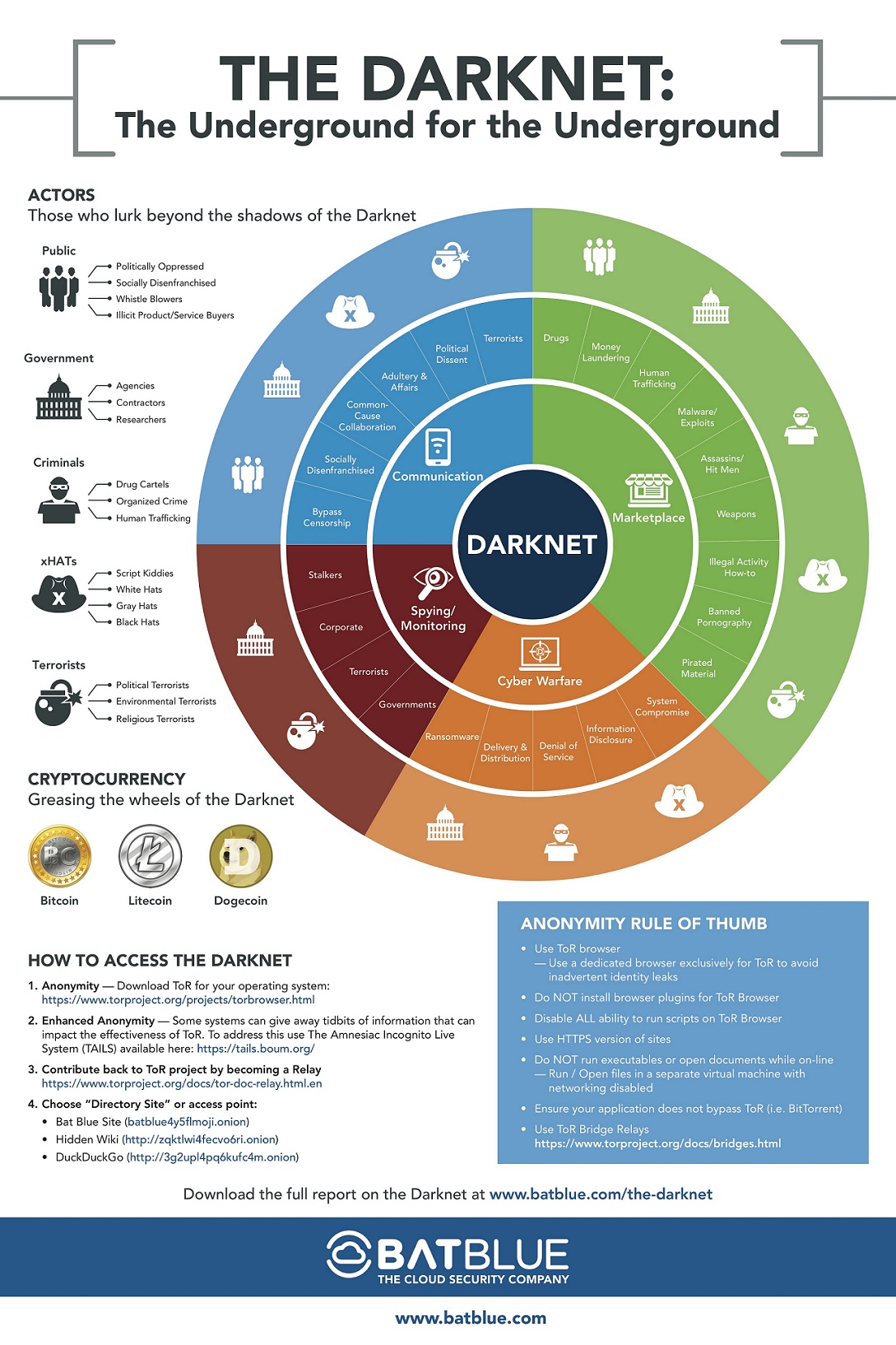
Infographic: The darknet: The underground for the underground

While the Darknet can be accessed by various means, most users use Tor, a sophisticated anonymization technology developed by the US Naval Research Laboratory in the mid-90s.

While writing our security articles on Softpedia, we mentioned the Darknet countless times in many of our articles. Unfortunately, most of the times, we make references to it because cyber-criminals have found a comfy home on it, using features initially created for protecting military and espionage personnel to hide their trail of illegal activities from authorities.

It is true that the Darknet is the place to find a lot of illegal products ranging from guns to drugs, and from child pornography to cyber-warfare tools, but there are many other Internet users who employ it to freely express political views, disclose government abuses, and exchange information in a safe and truly anonymous manner (journalists for example).

Accompanying Bat Blue's infographic seen below is the company's The Darknet report, which introduces users to the basic principles of the Dark Web, showing them how to correctly access it without losing their anonymity by exposing information they did not know could be leaked.  If you're a security newbie, the report is a must-read.


Referance: www.news.softpedia.com

Infographic: The darknet: The underground for the underground

While the Darknet can be accessed by various means, most users use Tor, a sophisticated anonymization technology developed by the US Naval Research Laboratory in the mid-90s.

While writing our security articles on Softpedia, we mentioned the Darknet countless times in many of our articles. Unfortunately, most of the times, we make references to it because cyber-criminals have found a comfy home on it, using features initially created for protecting military and espionage personnel to hide their trail of illegal activities from authorities.

It is true that the Darknet is the place to find a lot of illegal products ranging from guns to drugs, and from child pornography to cyber-warfare tools, but there are many other Internet users who employ it to freely express political views, disclose government abuses, and exchange information in a safe and truly anonymous manner (journalists for example).

Accompanying Bat Blue's infographic seen below is the company's The Darknet report, which introduces users to the basic principles of the Dark Web, showing them how to correctly access it without losing their anonymity by exposing information they did not know could be leaked.  If you're a security newbie, the report is a must-read.


Referance: www.news.softpedia.com

Thursday, September 15, 2016

The complex, dangerous and disturbing underworld that is the Darknet


The Darknet is the non-indexed, secret section of the Deep Web that is primarily, although not solely, used by those engaged in illegal and criminal activities. It’s a complex, dangerous and disturbing world that stretches to the most hidden corners of the encrypted web. What makes the Darknet so fascinating to many, is that it cannot be accessed through our regular browsers. It is a group of websites with .onion domains and the browser software needed to access these sites is called ‘The Onion Router’ or Tor. 

With Tor, you can access directories, free-for-all link dumps and wikis that can help you find whatever you are looking for; all without having to give up your IP address. Another ‘privacy network’ on the Darknet, the Invisible Internet Project or I2P, is also steadily gaining popularity. I2P offers various improvements such as file storage and sharing, secure mail as well as blog and chat features. The architecture of the Darknet was originally developed in 2002 – by the US Navy – with the purpose to provide a platform for anonymous communication. The way data is routed through layers makes it virtually untraceable which also inspired the moniker ‘anonymous net’. There are between 7,000 and 60,000 onion sites on the Darknet.


Who uses the Darknet?
As Tor was initially developed by the US Navy – military, law enforcement and government organisations are among some of the main Darknet users.
The ‘normal’ Internet can easily reveal your location and whom you are communicating with – even if encryption is used – which is dangerous for intelligence agencies, military personnel and those involved in top secret political negotiations. The Darknet is also popular in countries where political imprisonment and censorship are commonplace. You will therefore find many bloggers, whistleblowers, activists, information-leakers, revolutionaries and journalists there. The anonymity of the Darknet enables them to communicate without fear of getting caught and to organise themselves without giving away their location. The Darknet is also teeming with criminals and sinister groups such as drug dealers, pornographers, political extremists, assassins, and hackers. On its numerous notorious markets, one can buy goods and services with a mere click of the mouse, pay with Bitcoins or other cryptocurrencies and have your order delivered directly to your door.


The rise and fall of the notorious Silk Road market
One of the most well-known Darknet sites was the notorious Silk Road drug market. It was the largest of its kind on the Internet and only accessible via Tor – hidden from the public eye. In 2013, Ross William Ulbricht, Penn state graduate student and mastermind and founder of Silk Road, was arrested and his site taken down by the FBI. Ulbricht was charged with drug trafficking, computer hacking and money laundry, and the FBI seized about $33.6 million in Bitcoins, the last of which were auctioned off in November last year. To many, taking down Silk Road may have felt like a victory in the fight against crime, but the truth is that many other sites like these immediately popped up in its place. In the meantime, we have already seen the emergence of new marketplaces like Silk Road 2.0 and 3.0 as well as Evolution and tens of thousands of other sites. There, the sale of weapons, drugs, child pornography, counterfeit documents and even assassinations is business as usual.

Drugs – from cigarettes to Devil’s Breath and free samples to boot
There are thousands of drug listings on the Darknet, ranging from the ‘harmless’ cigarette to designer drugs, heroin, cocaine, steroids and everything in between. What’s most bizarre is that some dealers even offer their customers free drug samples. To give you an idea of what’s available: there are over 3,000 cannabis listings, hundreds of listings for heroin, over a thousand for psychedelics such as shrooms and LSD, more than 2,000 for ecstasy and a thousand-plus listings for painkillers and stimulants such as Ritalin and Adderall. Happy customers can submit product ratings and you often come across posts such as this marijuana review: “Very potent and clean weed. Sensational smell, 30 grams on scale ;-)” The scariest drug in the world, Devil’s Breath, is also for sale on the Darknet. When blown into someone’s face, the drug is said to ‘zombify’ its victim, leaving them at risk of being raped, their homes burgled, their bank accounts emptied or their organs stolen. Although the mysterious drug has been blamed for thousands of crimes, the degree to which the stories are true remains unknown.


Snuff movies and crush movies – not your average porn

While ‘average’ pornography is easily accessible on the Internet, the kind of porn you find in the trenches of the Darknet is a whole new level of disturbing. There’s an abundance of child pornography and content related to child abuse. Rape movies and snuff movies are hot commodities, and then there’s crush porn – in which animals are brutally murdered. The proliferation of these kinds of pornography is one of the most unsettling aspects of the Darknet and because of the cryptic veils these sites hide behind, they are very complicated to remove.


Forums that encourage eating disorders and even suicide

It gets worse. The Darknet is also home to forums where people suffering from eating disorders and depression get together to socialise with like-minded people. These forums are used to exchange tips and tricks related to how to best starve yourself and members are praised for going days without any food. On suicide forums, members are encouraged to embrace their dark thoughts and to find likeminded individuals to form suicide pacts with. Although deemed loathsome by many, others find them liberating and even therapeutic, as they enable members to ‘exercise their demons’, to speak freely and openly about their disturbing thoughts and actions.

Fake passports, social security numbers, credit cards and more

Among forged documents that you can buy on the Darknet are fake 
Driver’s licences and social security numbers. You can also easily get digital passports of various countries. Actual passports are a little harder to get hold of but you can sometimes find them in the ‘services’ section for around $6000-$7000. Counterfeit money is also freely available; highly detailed fake versions of the real thing. Then there are thousands upon thousands of credit card numbers for sale for around $8 (and discounted when purchased in large quantities). These can be stamped onto blank cards and used online. One particular credit card seller on the Darknet received more than 1,000 positive reviews. You can also buy hacked bank accounts, PayPal accounts, Uber accounts and Netflix accounts – for just a few dollars each.

Shutting down the Darknet: an endless game of whack-a-mole?

In the year the original Silk Road was shut down by the FBI, a multitude of new illicit marketplaces such as AlphaBay, Agora and others popped up in its place and the Darknet economy more than doubled. According to a research study at Carnegie Mellon, the Darknet ecosystem currently generates more than $500,000 per day and while the FBI has pledged to try their hardest to close down as many of these sites as possible, it looks like there’s very little they can do. It’s like playing an endless whack-a-mole game. A recent Canadian survey acknowledged that: “The anonymity of the technology of the Darknet cuts both ways — while people can use the network for villainous purposes, people can also use it for good. Despite public opinion, shuttering anonymity networks is not a viable long-term solution, as it will probably prove ineffective and will be costly to those people that genuinely benefit from these systems.”

Referance : www.en.richardvanhooijdonk.com

Tuesday, September 13, 2016

Sheep Marketplace Owner Charged of Bitcoin Theft


According to reports, Tomáš Jiřikovský purported to be the owner of Sheep Marketplace, faces additional charges related to stealing bitcoins worth millions of dollars from the users of the site.
When he was arrested in March last year, law enforcement officials were planning to charge him for dealing in drugs.

However, they uncovered some of his other illicit activities during the course of the investigation.

Sheep Marketplace gained a great deal of popularity following the closure of the original Silk Road marketplace.
However, little information was available about the site’s owner after the arrest.

Jan Danek, South Moravian police’s economic division head, reportedly informed a local news outlet some details related to the arrest and investigation of the owner of Sheep Marketplace.

During the period 2013-2014, law enforcement officials arrested two men from Florida for stealing as much as 5,400 bitcoins from Sheep Marketplace.

However, the amount of digital currency stolen by Jiřikovský was far greater. At that time, it was reported that as much $40 million worth of bitcoins had been stolen.

In the case of the Florida men, law enforcement officials traced the bitcoins they stole using services such as Blockchain.info.

In a similar fashion, the officers tracked the suspicious transactions even after the shutdown of Sheep Marketplace, according to Danek.

South Moravian police came to know of Sheep Marketplace only after its disappearance caused major disturbances on the internet.

Law enforcement was notified that a man from South Moravia, whose profile resembled that of the owner of Sheep Marketplace was receiving suspicious transactions.

This prompted the law enforcement officials to start tracing the money that was being deposited into the bank account of Jiřikovský’s wife, Eva Bartošová.

She received $38,000 from abroad and was connected to the case on money laundering charges.

On further investigation, police officials found out that more money was transferred to Jiřikovský’s realtor and that he had purchased a house for approximately $300,000 in his grandfather’s name.

The police officials continued their investigations into the case and discovered that Jiřikovský actually owned the Sheep Marketplace.

In addition to buying a new home, he had bought luxury furniture, new cars, and expensive computers.

Danek noted that purchases made by Jiřikovský during the nine-month period when the investigation was carried out added up to more than $800,000.

However, everything, including the cars and house, has been seized from him by the authorities.

According to the authorities, the money he received into his account was laundered from overseas accounts.

He exchanged the bitcoins overseas before transferring the money into his account as well as his wife’s account through Air Bank.

Jiřikovský, who is currently in police custody, faces up to twelve years in prison for stealing bitcoins and perpetrating drug trade.
Additionally, his wife has been charged with helping him to launder money.

The police have not detained his wife as of now, but Hynek Olma, a spokesperson from the office of the South Moravian prosecutor, said that Bartošová could face up to eight years in prison if convicted.

Sheep Marketplace which gained a great deal of attention in the dark web following the downfall of the original Silk Road website was not taken down by any of the law enforcement agencies.

The owner of the dark web marketplace made away with his customer’s money.

Reference: www.darkwebnews.com